
Guilds, megastructures and the long game
You can play Emparity alone, but the biggest things in the game are built by guilds. Here is how a guild works and what it can build together.
In this guide 9 sections
Why join a guild
A guild is a group of empires with a shared chat, a treasury, shared map notes and diplomacy. In practice a guild gives you three things a solo player doesn't have: more eyes on the map (members share scouting), help in a fight (fleets can defend each other's colonies), and the great works, which no single empire can build.
Founding and joining
Anyone can found a guild from the Guild screen with an unused name and a short tag of capital letters or numbers. The founder becomes the Leader. To join an existing guild, search for it and apply with a short message, or accept an invite from one of its officers. New members start as Recruits. You can only be in one guild at a time, and after leaving a guild there is a short wait before you can join or found another.
Ranks
Ranks decide who can accept applications, send invites, change other members' ranks, withdraw from the treasury and start megastructures. Every rank can chat in the guild channel and deposit into the treasury. You can only remove members ranked below you, and nobody can remove the Leader. A Leader who wants to leave hands leadership to someone else first.
Treasury and tax
Members deposit credits from any of their colonies. A guild can set a tax, which sends part of every member's credit income to the treasury automatically. Withdrawals go to a colony you choose, up to your rank's daily allowance, and every movement shows in the treasury log.
Crests
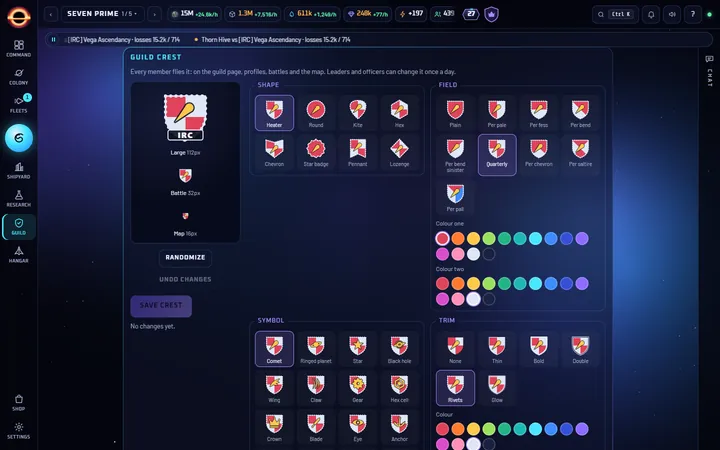
Every guild has a crest, built from a shield shape, a field in up to three colours, a symbol and trim, with optional letters. Leaders and officers design it, and every member flies it in battle replays, on the map, in rankings and on the killboard. Players without a guild fly a crest of their own.
Diplomacy
Guilds can mark other guilds as allies or hostile, or declare war. Allies' fleets can defend your colonies. War and hostility also lift the bully limit between the two guilds, so a big empire can fight a smaller one from an enemy guild.
Harvester Rings
A Harvester Ring is a guild megastructure built around a whole world: an ice, lava or toxic world, or a gas giant, in a system where a member has a colony. Members fund it in stages with credits, metal and rare minerals. Once complete it mines on its own into a shared hold, and every member collects from it with their own Freighters. A ring follows its world's own metal, gas and mineral ratings, so choosing the right world matters. It is a building, not territory, and giving to it buys a place on its contributors board, not power.
The Dyson Sphere
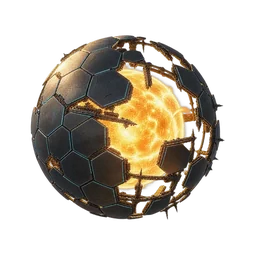
The Hall, the guild's megastructure screen, is built around the Dyson Sphere. Once the right research is done, a guild can start one at a star in a system where a member has a colony. Each star holds one sphere. Members give from their colonies, ranks with permission add credits from the treasury, and each fully paid stage builds for its time before the next one opens.
A finished sphere gives the guild's colonies in that system a large energy boost, and its colonies elsewhere in the galaxy a smaller one. Spheres never stack, so each colony gets the best one available. Megastructures can't be captured or destroyed.
The Ascendant
The Ascendant are not players. They gather in hidden outposts in the quiet middle reaches of a galaxy and, when they are ready, they break through and invade, seizing systems near their rift and striking at empires. Great works draw their attention: every finished megastructure stage in a galaxy makes the invasions there stronger. Fighting them earns ancient fragments, which a guild needs for the greatest work of all.
The Singularity Tap
The Singularity Tap is built at the core black hole of a galaxy. Each core holds one Tap, and the first guild to start one there owns it. To start it, a guild needs a finished Dyson Sphere in that galaxy, a member colony in the core, the right research, and ancient fragments earned against the Ascendant.
Once the Tap is built, the guild can start its Ignition. The whole server hears about it: a banner for everyone, a notification and a mark on the map. While it burns, anyone may attack the core under the usual rules, and the guild has to keep a colony or a stationed fleet there for three days while everyone comes for it. It is the end-game moment of a season.
Getting the most from a guild
- Share your surveys. A guild that scouts together sees attacks coming.
- Station defending fleets over guildmates who are offline.
- Migrate together. When a new galaxy opens, moving in as a group gives everyone safe neighbours.
- Use the shared map notes to mark targets, threats and good colony sites.